MALAYSIA SHOWCASES COMMITMENT TO ACCELERATE ENERGY TRANSITION THROUGH GLOBAL LESSONS
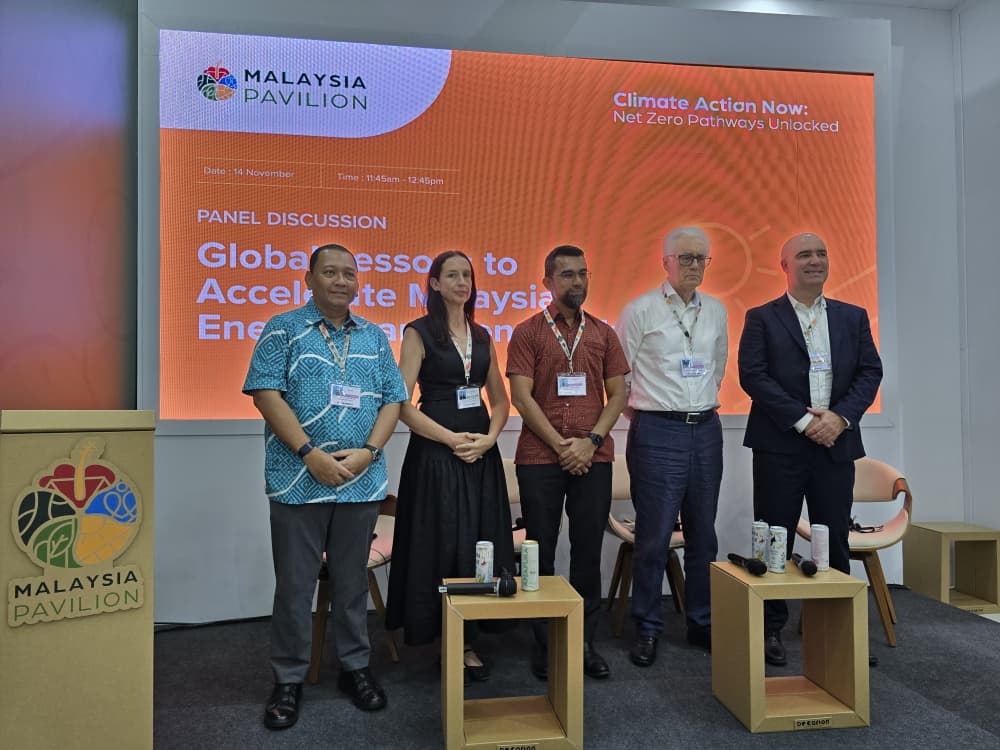
Brazil, Friday, 14 November 2025: Chief Executive Officer of the Sustainable Energy Development Authority (SEDA) Malaysia, Dato’ Hamzah Hussin, led Malaysia’s delegation to the session titled “Global Lessons to Accelerate Malaysia’s Energy Roadmap” held at the Malaysia Pavilion, Brazil.
During the session, Dato’ Hamzah emphasized that the challenge is not merely to set higher targets, but to translate global lessons into local action—bridging the gap between policy and implementation, and between ambition and actual deployment.
“Malaysia’s commitment to the Paris Agreement and our target of achieving net-zero emissions by 2050 form the cornerstone of our National Energy Transition Roadmap (NETR). The roadmap envisions a 70% renewable energy capacity mix by 2050, with an interim target of 31% by 2025.
“The NETR outlines six key transition levers — renewable energy, energy efficiency, hydrogen, bioenergy, green mobility, and carbon capture, utilisation and storage (CCUS). The roadmap projects RM1.2–1.3 trillion (USD 284–307 billion) in cumulative investment needs, signaling not just a financial challenge but a transformative opportunity to stimulate economic growth, create high-value green jobs, attract quality investments, and strengthen Malaysia’s overall energy security and competitiveness,” he said.
“At the High-Level Dialogue, Malaysia reaffirmed its commitment to learning through a range of strategic global collaborations aimed at advancing sustainable progress. These partnerships bring investment, technology and long-term market access for hydrogen, biofuels and carbon-capture initiatives.
“Malaysia is putting these lessons into practice by expanding Green Sukuk, cross border cooperation through the ASEAN Power Grid, investing in grid modernisation and storage, and expanding reskilling and upskilling through strengthened TVET institutions. These steps reinforce capacity, market readiness, and investor confidence over time,” he added.
Dato’ Hamzah further highlighted that Malaysia is progressing from pilot projects toward system-wide integration, aligning policy, finance, and infrastructure into one cohesive ecosystem.
“Cross-border initiatives such as the ASEAN Power Grid and potential hydrogen and CO₂ corridors will further accelerate regional collaboration. With the support of the World Bank and Asian Development Bank’s, the Regional Project Preparation Facility under the ASEAN Centre for Energy is transforming regional plans into bankable projects,” he continued.
He added that the energy transition is no longer a trade-off between growth and sustainability, but rather an effort to align both in pursuit of shared progress.” By combining stable policies with investable projects, modern infrastructure, and skilled human capital, Malaysia aims to lead the development of a secure, affordable, and low-carbon energy system in Southeast Asia. We must work together to ignite the energy shift — powering Malaysia’s progress, strengthening ASEAN’s resilience, and lighting the path toward a sustainable future for all,” he concluded.
Among the thought leaders contributing to the session were Moderator Kate Hughes, Senior Climate Change Specialist at ADB; Ir. Mahathir Nor Ismail, Chief Distribution Network Officer of Tenaga Nasional Berhad (TNB); Lord Adair Turner, Chair of the Energy Transition Commission (ETC); and Derek Baraldi, Head of Sustainable Finance at the World Economic Forum (WEF)
ENDS.